
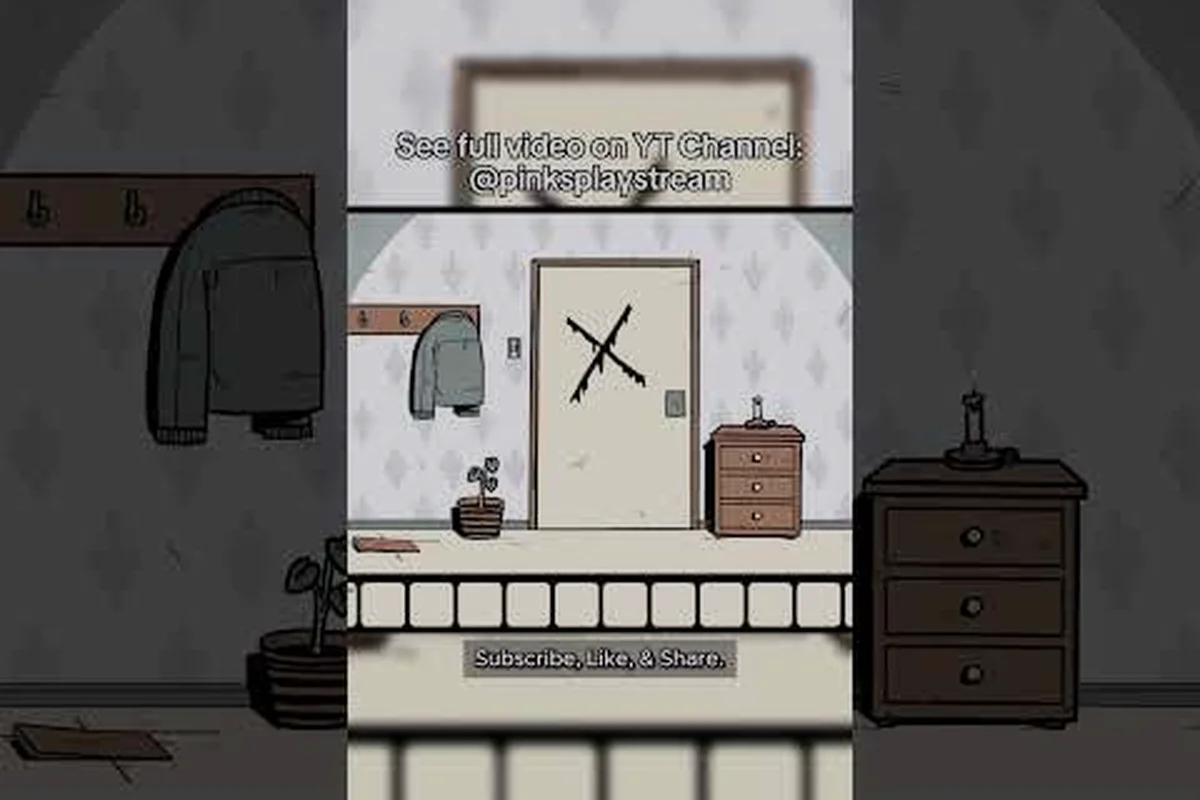
The girl in the window Mia backstory sits at the center of Dark Dome's first Hidden Town chapter, because every diary page, faded photograph, and locked drawer in that abandoned house points back to a single girl who never got to leave. The 2019 mobile release and the 2026 Steam port both open the same way: Dan walks into a house the villagers have been avoiding for twenty years, the door clicks shut behind him, and the silhouette at the upstairs window turns out to be more than a local legend. This guide pulls together every canonical clue about Mia and Dan, lays out who actually locked the door, and tracks how these recurring characters keep reappearing across the Hidden Town universe.
The picture below the stairs is the one most players screenshot first, and it is also the cleanest entry point into Mia's side of the story. A faded school portrait, a date stamped in the corner, and a girl's face half-erased by the same kind of shadow that later drifts across the hallway. Pair that with the diary Dan finds in the upstairs desk and the tone of the whole game shifts from a locked-room puzzle into a character study about two people who missed each other by twenty years.
Mia's Life Inside the Abandoned House
The girl in the window Mia backstory is built from physical evidence rather than dialogue, because Mia never speaks on-screen. The game scatters her belongings through drawers, wardrobes, and a locked upstairs bedroom, and the order in which you find them roughly mirrors the order of her life inside the house.
Photographs, Yearbook, and the Family Tree
The downstairs hallway hides a small photo wall with three frames still attached and one frame hanging by a single nail. The earliest photo shows a couple standing in front of the same house, the second shows a baby held in a white dress, and the third shows a teenage Mia in a school uniform. The dates stamped in the corners are spaced roughly five to six years apart, which lets you back-calculate that the family moved in around the time the baby was born. A loose fourth photo in the upstairs desk shows the same couple without Mia, captioned in pencil with a location that matches a town further north.
| Photo | Date Stamp | Subject | What It Confirms |
|---|---|---|---|
| Frame 1 | ~1974 | Couple, front of house | Family built or bought the home two decades before the game begins |
| Frame 2 | ~1979 | Baby in white dress | Mia born into the household, white-dress motif established early |
| Frame 3 | ~1994 | Teenage Mia, school uniform | Mia lived in the house through her teen years |
| Loose, desk | ~1995 | Couple only | Parents left the house, possibly without Mia |
The white dress is important, because it is the same dress the figure behind the upstairs window is wearing. Players who jump to a "ghost in a nightgown" reading are technically right about the visual but wrong about the timeline, since the photo series shows Mia wore the dress as a toddler, not as a ghost.
Diary Pages and the Order They Unlock
The diary you piece together is not paginated cleanly. You find entries stuffed inside books, pinned under floorboards, and taped behind a broken mirror. The order in which the diary text becomes readable depends on which puzzle you solve first, but the content always lays out the same arc.
-
Entry 1 — The Locked Room: Mia describes a room in the house that her parents kept shut. She is curious but not yet afraid.
-
Entry 2 — The Stranger in the Hallway: Mia sees a tall figure she does not recognize. The figure does not speak, and her parents refuse to discuss it.
-
Entry 3 — The Music Box: A music box starts playing on its own at night. Mia traces the sound to the upstairs bedroom.
-
Entry 4 — The Empty House: Mia writes that her parents have stopped coming home, and the kitchen pantry is running low.
-
Entry 5 — The Window: Mia mentions looking out the upstairs window at the village, hoping someone will notice her.
That fifth entry is the line the title of the game is built on, and it also explains why villagers twenty years later still claim to see a girl at the window. The villagers are not reporting a haunting so much as reporting the aftermath of a child who kept waiting and never got an answer.
Why Mia Never Leaves the House
The diary never names the thing Mia is hiding from, but three pieces of in-game evidence point to the same answer. First, the upstairs bedroom door is locked from the inside when Dan arrives, even though the rest of the upstairs is accessible. Second, the tall figure Mia saw as a child has the same silhouette as the shadow that drifts across the hallway every time Dan solves a major puzzle. Third, the music box only plays when Dan is alone in a room, which is the classic locked-room pattern of an entity that can move through the house but cannot leave the property line.
The simplest reading, which the community generally agrees with, is that Mia is not a ghost in the traditional sense. She is a person who got trapped in the house by the same entity her parents feared, and the upstairs window is the only part of the house still connected to the outside world. Twenty years of staring out of that window is what villagers keep catching out of the corner of their eye.
Dan's Backstory and Why He Walks Into the House
The girl in the window Dan backstory is shorter than Mia's, because Dan is a player avatar rather than a built-in resident. He is not a police officer, a paranormal investigator, or a relative of the family. He is a curious outsider who has heard the local story and decided to see the house for himself. The Steam store page for the game frames him that way directly, calling him a curious guy who has entered an abandoned house and ended up locked inside. That is the entire pitch for his character, and the rest of the personality comes from how the puzzles react to his choices.
Dan's Relationship to the Hidden Town Universe
Dark Dome has been clear that The Girl in the Window is the first chronological chapter in the Hidden Town series, which means Dan is also the first character the player meets across the entire nine-game run. He reappears in the series' fourth chapter, The Ghost Case, this time working alongside Detective Ren Larsen. The community has read that reappearance as confirmation that Dan is a fixed point in the universe, not a one-off protagonist.
| Game | Release Order | Dan's Role | Mia's Role |
|---|---|---|---|
| The Girl in the Window | Chapter 1 | Player character, locked inside the house | Silhouette behind the upstairs window |
| Unwanted Experiment | Chapter 2 | Referenced in newspaper clippings, not seen | Not present |
| Nowhere House | Chapter 3 | Referenced again, name appears on a shipping label | Not present |
| The Ghost Case | Chapter 4 | Supporting role alongside Ren Larsen | Appears as a photograph, diary page, and brief spectral figure |
That table matters for the longer reading of the game, because it tells you the developers are not telling one self-contained ghost story. They are introducing Dan and Mia in chapter one so that every later chapter can refer back to them, the same way a TV pilot introduces its leads and then drops in cameo flashbacks across the rest of the season.
What Dan Knows Before He Enters the House
Nothing in the game confirms that Dan has read the local stories, heard the rumors, or done any kind of research before he walks up to the front door. The introduction sequence shows him simply crossing the gate, stepping onto the porch, and trying the handle. The fact that he enters alone, at what looks like late afternoon, and without a flashlight or phone, reads less like detective work and more like casual curiosity. The locked door trap works because he is already inside before he thinks to check whether the door is a normal door.
That framing is intentional. Dan is not a hero walking into danger. He is a regular person walking into a house, and the game is built around the moment that choice becomes a mistake.
The Crossover Cameo in The Ghost Case
The Ghost Case is the easiest follow-up chapter for players who want to see Dan outside the house. He appears in a few short scenes and in several pieces of case evidence, and his behavior in those scenes matches the personality established in the first game: curious, willing to break rules if the puzzle demands it, and slow to notice when the supernatural is happening right next to him. The cameo also confirms that he survived the original house, even though the original game does not show what happened to him after the front door opens again. For a deeper breakdown of the supporting cast that surrounds Dan, the character guide lays out every named face Dan meets across the Hidden Town run.
Who Locked the Door, and Why
The girl in the window who locked the door is the question players ask the most after finishing a first playthrough, because the lock happens on-screen, it happens fast, and the game never pauses to explain it. There are three readings in the community, and each one is supported by a different set of in-game evidence.
Reading 1: The House Did It
The first reading is the simplest, and it is the one the puzzles themselves support. Every locked drawer, every blocked hallway, and every door that clicks shut in the game follows the same pattern. Something reacts to a solved puzzle. The door at the bottom of the stairs locks immediately after Dan opens the upstairs bedroom for the first time. The hallway door locks the moment Dan picks up the music box. The pattern is consistent enough that the house behaves like a single mechanism, and the front door lock is just the first and most visible example.
Reading 2: Mia Locked the Door
The second reading treats the lock as Mia's choice. The upstairs bedroom door is already locked from the inside when Dan arrives, which suggests Mia has been controlling parts of the house for a long time. Under this reading, Mia locks the front door because she does not want Dan to leave before he has seen what she has been trying to show the outside world for twenty years. The diary entry about hoping someone will notice her is the strongest support for this reading, because a girl who wants to be noticed would not let the one person who walked in walk back out.
Reading 3: The Entity Locked the Door
The third reading treats the lock as the work of the tall figure from Mia's diary. The shadow that drifts across the hallway gets longer every time Dan makes progress, which implies a presence that is interested in the puzzles being solved but does not want anyone to leave. The same shadow shows up in the upstairs bedroom mirror and in the reflection of the music box, so the figure is bound to the house and to Mia but is not Mia herself. Under this reading, the front door locks because the entity wants the show to continue, and Mia is as much a prisoner of the lock as Dan is.
| Reading | Main Evidence | Implication for Dan | Implication for Mia |
|---|---|---|---|
| House did it | Every lock in the game reacts to a puzzle solve | Dan is a participant in a mechanism | Mia is a feature of the mechanism |
| Mia did it | Diary entry 5, upstairs door already locked | Dan is a witness Mia has been waiting for | Mia is the closest thing the game has to an antagonist with a sympathetic motive |
| Entity did it | Shadow appears after every solve, music box only plays when Dan is alone | Dan is bait | Mia is also a prisoner, not an agent |
The community generally treats all three readings as compatible, because the game never forces a single interpretation. A player who wants a clean horror reading can take the entity explanation. A player who wants a tragic reading can take Mia's explanation. A player who wants a mechanical reading can take the house explanation. The genius of the design is that none of those readings breaks a puzzle or contradicts a diary page.
Where Mia and Dan Reappear in Later Dark Dome Episodes
The girl in the window character appearances stretch well past the first game, and the developers have been deliberate about the cameos. Dan and Mia keep showing up in later chapters, sometimes as playable characters, sometimes as photographs, sometimes as off-screen references in newspaper clippings. Tracking those appearances is the easiest way to see how the larger Hidden Town story is structured.
The film has drawn extensive online discussion, with audiences sharing their interpretations of Anna's mental state and unreliable memory in threads such as the official discussion of The Woman in the Window on r/movies, where viewers debated whether her story of the girl next door was a distorted reconstruction of trauma.
Recurring Characters in Order of First Appearance
The Hidden Town series is laid out in the order Dark Dome recommends playing, and the recurring character roster builds up chapter by chapter. The first four chapters alone are enough to establish a pattern.
-
Dan — first appears in chapter one, returns in chapter four as a supporting character.
-
Mia — first appears in chapter one as a silhouette, returns in chapter four as a photograph and a spectral figure.
-
Ren Larsen — first appears in chapter four as the lead detective, anchored to the same investigation Dan stumbled into in chapter one.
-
The Tall Figure / The Shadow — first referenced in Mia's diary in chapter one, returns as a physical entity in chapter four.
-
The Music Box — appears in chapter one, reappears in chapter four as a piece of evidence on Ren Larsen's desk.
The pattern is that characters introduced in chapter one do not just recur; they recur with extra context that retroactively changes how the first game reads. The diary entry that seemed like a child's complaint in chapter one reads very differently once you have seen the entity up close in chapter four.
Why the Cameos Matter for the Backstory
Cameos are usually treated as fan service, but in this series they are structural. The Girl in the Window is the only chapter that places the player inside Mia's house, and every later chapter either refers back to that house or shows characters who were shaped by it. The murder case file that drives The Ghost Case is a direct continuation of the same investigation Dan interrupted by walking into the wrong door twenty years earlier, and a full write-up of that case sits in the murder case deep dive if you want the side-by-side evidence comparison. The series is essentially one long argument that Mia's story never ended when the credits rolled, and the cameos are how the developers keep that argument going without forcing every player to read the later chapters in a specific order.
Frequently Asked Questions
What does the girl in the window Mia backstory actually reveal about her age?
The photo wall in the hallway lets you back-calculate that Mia was a teenager when the house was still occupied, and the diary entries were written when she was around the same age. By the time of the game, twenty years have passed in the village timeline, which is the source of the rumor that the girl in the window is a ghost. The game never gives an exact birth year, but the photo dates are consistent with a character who lived her entire adolescence inside the house.
Is the girl in the window Dan backstory different in the mobile and Steam versions of the game?
The core backstory is identical across versions, because both releases use the same script and the same room layouts. The Steam port adds higher-resolution art, a hint system, and cloud saves, but it does not add new diary pages or change Dan's motivation. Players who finished the mobile original will recognize the same character, the same locked door, and the same ending beats on Steam.
Who locked the door in The Girl in the Window, and is there a canon answer?
There is no single line of dialogue that names who locked the door, so the game never locks the player into one answer. The strongest in-game evidence supports the house itself as the locking mechanism, with Mia and the tall figure as secondary explanations. Players who want the cleanest read usually combine all three: the house reacts, Mia chooses not to stop it, and the entity benefits from the delay.
Do Mia and Dan appear in any other Dark Dome games?
Yes. Both characters reappear in The Ghost Case, the fourth chapter in the Hidden Town series. Dan shows up as a supporting character working with Detective Ren Larsen, and Mia appears as a photograph, a diary page, and a brief spectral figure. A wider sweep of the cameos and the supporting cast is covered in the Dan in other Dark Dome games breakdown, which maps every reference across all nine chapters.
Is Mia a ghost, a memory, or something else in the game?
The evidence points to Mia being a real person who is still inside the house, which makes her neither a classical ghost nor a memory. The upstairs door is locked from the inside, the diary is written in present tense, and the diary pages are physical objects Dan picks up. The supernatural layer of the story is the tall figure, not Mia herself, and most of the community reads Mia as a captive rather than a haunting.